Pebbles and Powder
Small stones. Big plans. Build a little fortress from humble pebble posts to thundering cannons, and defend a polygon valley with one to six players.
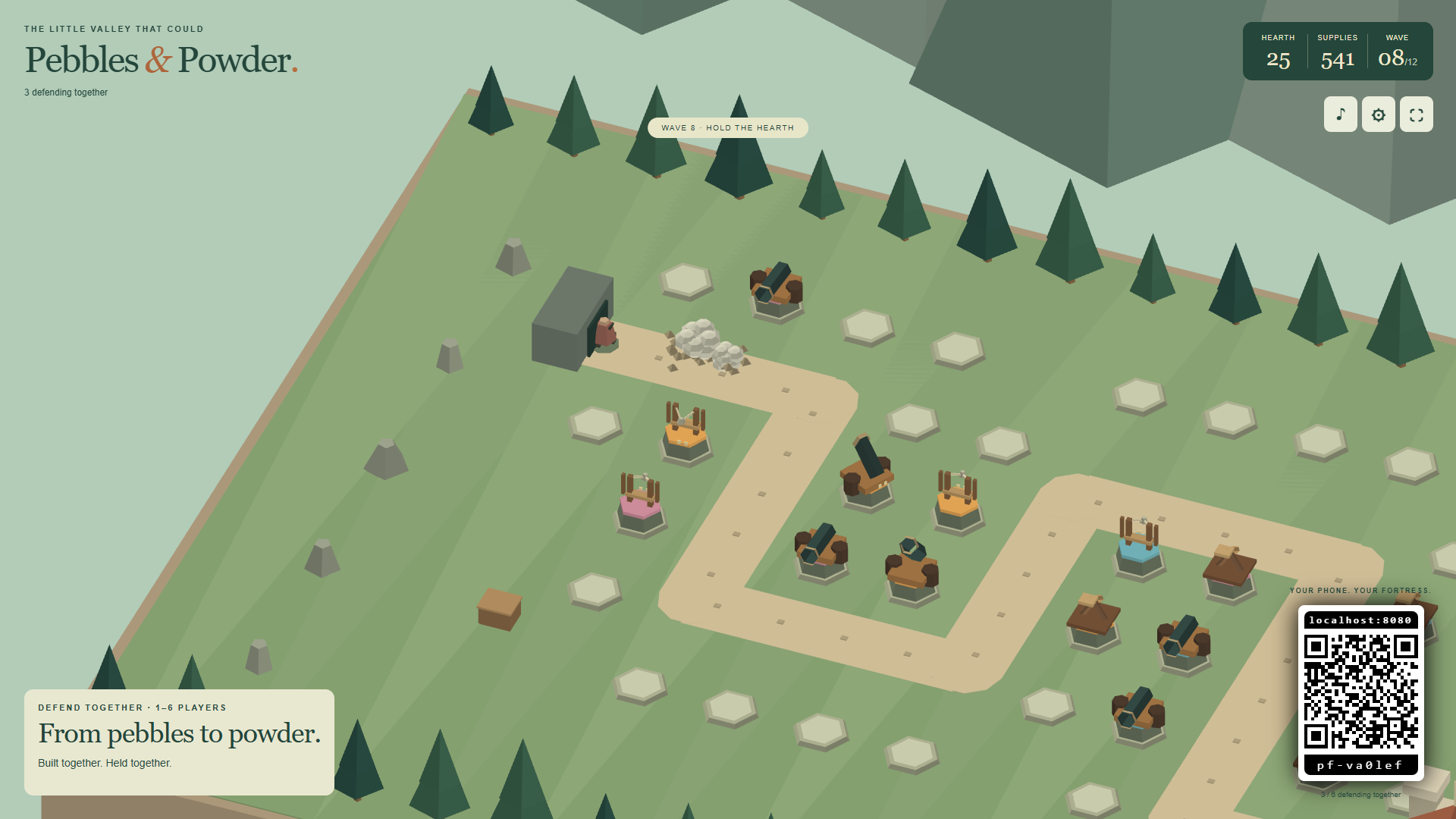
The display follows the action with a moving camera. Your phone provides an overhead view for planning and building. You can also play the complete game on a phone without a display.
Start a defence
Choose Pebbles and Powder in the RCWeb app launcher. The launcher opens the command screen on your phone and the cinematic view on any room displays. Alternatively, open the command app directly to play on your phone.
Friends scan the display's QR code or the invitation in your phone's + menu. Everyone must join the same room. If you opened the game on localhost, use the server's network address before sharing with other devices.
Tap a pale stone building pad and choose Pebble Post. Place another if you like, then press Start the siege. Towers fire automatically. You can keep building and upgrading during combat.
From pebbles to powder
- Pebble Posts are available immediately. Their repeated hits crack armour so heavier weapons can do more damage. Upgrades add stronger sling mechanisms.
- Stone Lobbers unlock at wave 2. Arcing stones damage groups and slow them down.
- Powder Cannons unlock at wave 4. Their heavy shots exploit cracked armour and strike nearby enemies.
- From wave 7, a cannon can become a Scatter Cannon for wide blasts or a Mortar for long-range bombardment.
- Towers have three upgrade levels. Different weapons complement one another; keep some stone weapons when powder arrives.
The team shares supplies, towers and hearth health. Any player may improve a tower. Supplies come from defeating enemies and clearing waves. Selling returns 65% of the tower's investment.
The twelve-step wave track shows your progress: green waves are cleared and the gold wave is underway. The counter includes both approaching and active raiders. Brief announcements introduce new weapons, warn of siege engines and mark cleared waves.
At the end, both screens show Victory or Defeat, waves cleared, raiders stopped and the team score. A failed wave does not count as cleared. The battlefield stops fighting while you review the result. Use your phone to start another defence, or choose Endless after victory.
Runners, shields, swarms and brutes require different combinations. Siege engines appear at waves 6 and 12; an orange upper hull signals their faster final charge. Survive twelve waves to win, then continue into Endless or start a new defence. Expect roughly 10–16 minutes for a successful twelve-wave siege, depending on team size and strategy.
Come and go
Each player adds five available tower places, up to thirty for six players. A larger team receives reinforcement supplies and faces more enemies. New technology unlocks for the whole team.
Built towers continue firing when someone leaves. A place is briefly reserved for reconnection before another player can claim it. Extra phones can watch while all six places are occupied.
Difficulty is set when each wave begins. Future waves consider both the active team and the towers left behind, so a large inherited defence still gets an appropriate battle. Rejoining does not repeatedly grant supplies.
If everyone leaves while a display remains, the current wave finishes and the next waits. An unused display shows a separate demonstration with a joining QR code. If the browser running the game disappears, another connected browser resumes from a shared checkpoint after a short pause; a small rollback is possible.
Sound and display
Select the music-note button on each device to enable or mute its sound. A display may require its own tap before its browser allows audio. Phones use quieter combat sounds when a display is present.
The gear menu includes reduced effects. The fullscreen button uses the browser's fullscreen mode where available. The display runs on browsers with WebGL 1 support; older displays use simpler effects. Device performance varies.
The phone saves a checkpoint around wave boundaries. After all browsers close, open the same room in a browser that saved it and choose Restore saved siege in the gear menu. Restoration is offered before a new siege has started. Nothing keeps running after every browser closes, and clearing browser storage removes its saves.
For touch controls and phone-only play, see Pebbles and Powder Command.