RCWeb Stack Above
Stack Above is a shared-screen reset-loop party card game for RCWeb. One browser tab becomes a bright shared playfield with the room code, turn prompts, draw pile, play stack, scoreboard, and animated round celebrations. Each player joins from a phone and keeps a private hand there, so the big screen can stay simple and exciting for kids.
It is designed for quick family play: open the display on a TV, projector, or laptop, let players scan the QR code, and begin as soon as at least two phones have joined.

Features
- A private hand for each of two to eight players.
- Match or step up a looping number ladder.
- Automatic new rounds and running penalty scores.
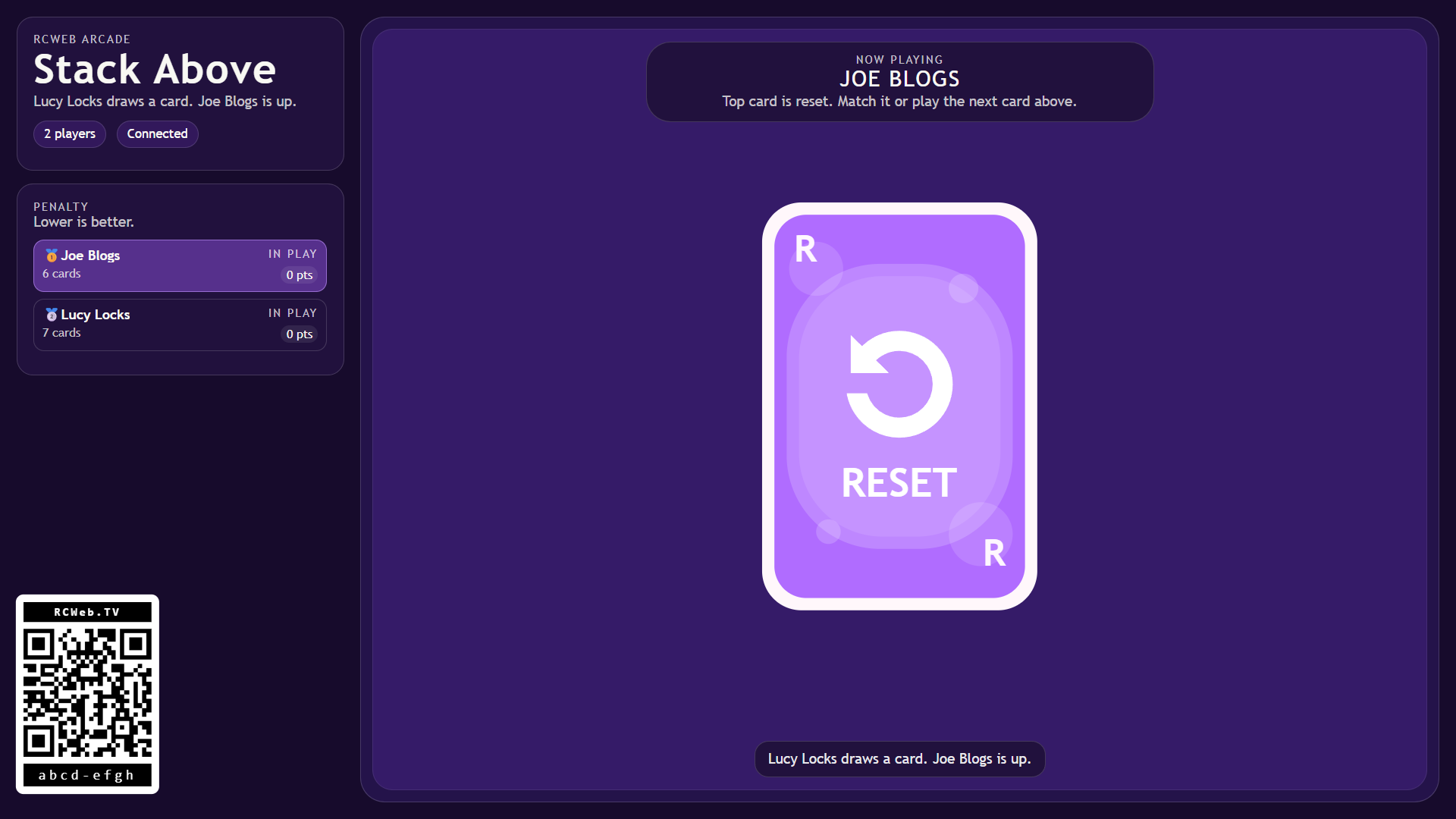
Screenshot
The Game
Stack Above keeps the same RCWeb pattern as Stack Snap, but shifts to a simpler loop-based ruleset. On your turn you either:
- play a card that matches the top card
- play the next higher card in the ladder
- draw one card
- sit out for the rest of the round if you are stuck
The ladder loops in a circle:
1can go on1orReset2can go on1or23can go on2or34can go on3or45can go on4or56can go on5or6Resetcan go on6orReset
Stack Above supports 2 to 8 players. Each round starts with 6 cards per player, and scores keep running from round to round with no fixed limit.
How To Play
Open /stack-above/ on the shared screen. Players scan the QR code to open /stack-above-c/ on their phones in the same room. When at least two players have joined, any phone can start.
Each stack contains the bright number cards 1 through 6 plus the special Reset card. Players try to get rid of their hands by following the stack upward. If a turn gets tricky, drawing a card is always allowed, and players can also choose to sit out for the rest of the round instead of taking more cards.
The round ends when:
- one player empties their hand
- everyone else has sat out, leaving one player still active
When a round ends, every other active player keeps the cards left in their own hand as penalty points:
- number cards are worth their face value
- each reset card is worth 10 points
After a round ends, Stack Above celebrates the winner and automatically deals the next round after a short countdown. Scores stay on the board until someone at the table decides to stop or restart.
Late arrivals can still join mid-round and will enter on the next deal.