3DRace
Race around Pine Circuit with up to eight human drivers in a sixteen-car field. Play on phones, tablets and computers in the same RCWeb room, or watch the action from six camera views. Three.js renders the original circuit and two-colour open-wheel cars in a flat, low-polygon arcade style. Current browsers with WebGL 2 are required.
Join and race
Open 3DRace. Racing starts automatically with AI opponents and continues in a loop. Select the steering-wheel icon to drive; switch it off to hand your car to AI and watch. During an active race, new drivers take over the lowest-placed available AI car without resetting its position or progress. Up to eight human places are available. Reserved and finished cars cannot be taken over.
Use the chain-link icon to show Join race on another device. Scan the standard RCWeb QR code to open the same room. When using a local server, open its network address instead of localhost before sharing with another device. Multiple tabs on one computer can share a localhost room.
Human entrants start behind the AI on each new grid. AI abilities vary: front-grid opponents are quicker than those toward the back. In Settings, the host can change Opponents between Relaxed, Standard and Fast during gameplay; changes apply immediately and carry into the next race. Restart race starts a fresh shared countdown. The host can change the lap selection between events.
Controls
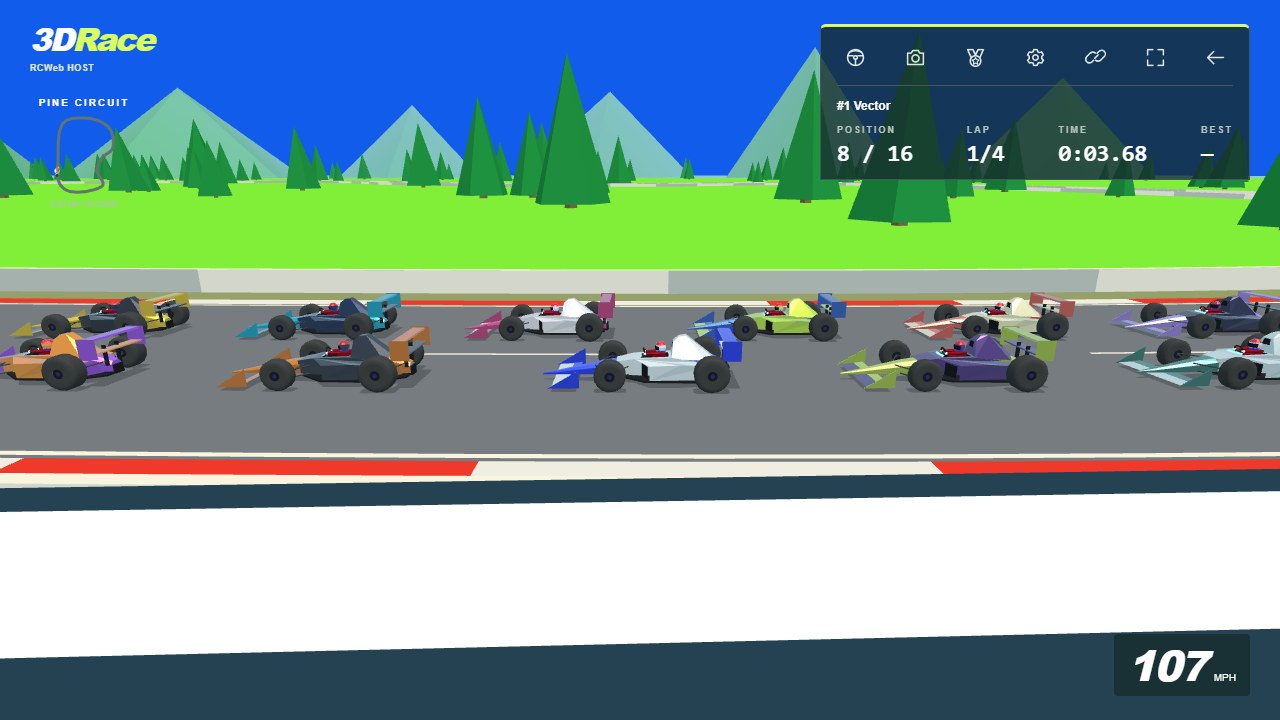
- Keyboard: W or up accelerates; S or down brakes and then reverses after stopping; A/D or left/right steer. C cycles cameras. R recovers a stopped or stranded car. P/Escape hands driving to AI.
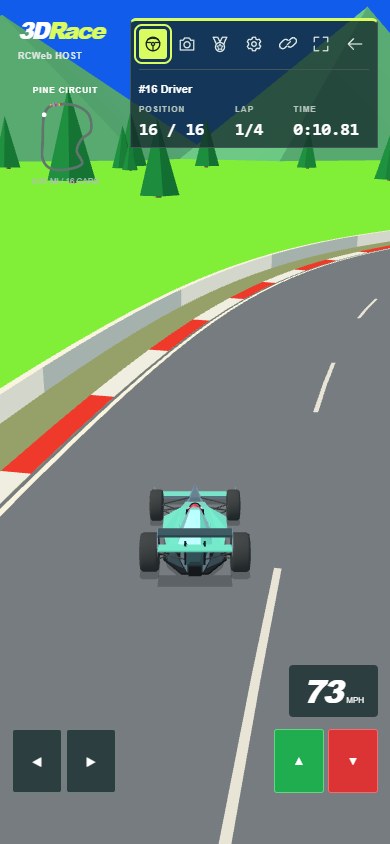
- Touch: hold the left/right steering arrows together with the green forward arrow or red brake/reverse arrow.
- Gamepad: left stick steers; right trigger or A accelerates; left trigger or B brakes and reverses.
Speeds are displayed in mph, and track length in miles. Reverse is limited to about 18 mph. Pressing both pedals stops the car. Grass slows cars, barriers contain them, and contact produces sparks, impact sounds and cosmetic damage. Damage resets at the next race and does not change performance. Occasional underbody sparks appear at speed. Very hard braking leaves subtle tyre marks on the asphalt. They remain for a minute before fading over thirty seconds; the oldest marks may be replaced when the fixed pool fills. The red rear light flashes during simulated energy recovery on braking or lift-off; this is a visual approximation, not a battery simulation. Reduced-motion mode suppresses sparks and uses a steady recovery light.
Settings → Recover car can move a stopped or stranded car a short distance back onto the track, with a two-second stop and temporary contact protection. Changing tabs clears driving controls and hands the car to AI. Return and toggle driving on to resume.
Interface and sound
The top-right icon row contains driving, camera, standings, settings, join, fullscreen and Back to apps. Back to apps asks for confirmation before leaving this device. Settings opens only when requested and lets you change your driver name and sound preference.
The selected driver's name, position and lap timing appear in the right panel, with recovery and finish notices below. Speed sits at the bottom right, above the touch pedals when shown. The track map and RCWeb Host/RTT status sit below the 3DRace title. The join panel opens beneath the main panel, aligned right on wide screens.
Engine sounds, tyre squeal, off-road rumble, impacts and countdown tones are generated locally. All sixteen engines are mixed by distance and stereo direction from the current camera, so nearby cars can be heard passing the trackside view. The overview uses a wider listening range to retain the sound of the field. Doppler pitch changes reflect cars approaching or receding relative to the camera; camera cuts and large network corrections reset the effect to avoid false pitch sweeps. Tap or press a key to enable audio; gamepad-only users may need to tap first. Settings → Sound remembers this device's mute preference. Hidden tabs are silent.
Watch the race
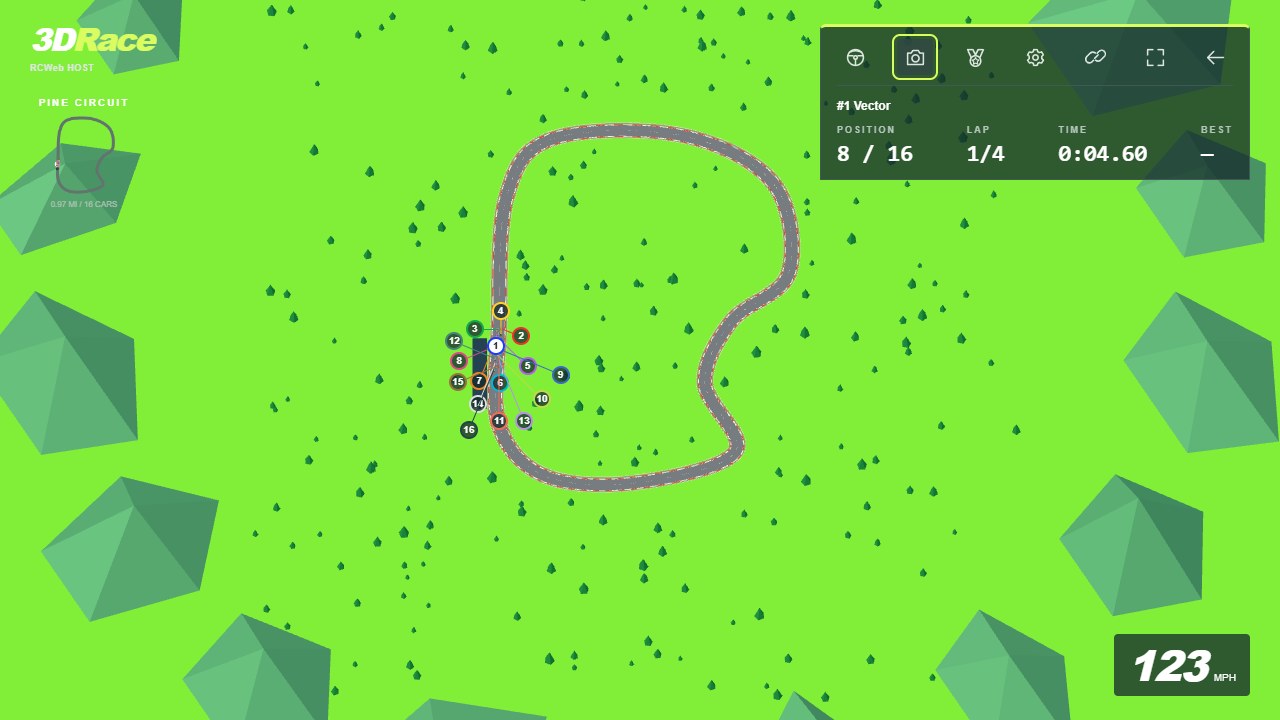
The game opens with the Trackside camera. Taking the wheel selects Chase; handing back to AI returns to Trackside. The camera icon cycles through Chase, High chase, Whole track, Nose, Trackside and Side.
Open Standings with the medal icon and use a driver's camera button to follow that car. Selecting another car while driving hands yours to AI. AI-controlled cars have an AI badge, and your own row is highlighted. The results use the same badge and highlight style.
Results and the next race
After the winner finishes, remaining cars have 45 seconds to finish before receiving DNF. Results show positions, total times and AI-assisted entries. A 15-second countdown runs while cars continue a slow victory lap. The next race starts automatically with the same difficulty, lap settings and returning entrants. Race records and cosmetic damage reset for the new event.
Shared rooms and reconnects
One browser hosts the official race. Other drivers predict movement locally while synchronising with it; spectators watch interpolated updates. Each device chooses its own camera. Disconnects hand cars to AI, and reloading the same tab can reclaim the car through session storage. Toggle driving on after reconnecting.
If the host leaves or becomes hidden, another foreground peer can resume from the latest checkpoint after a short synchronisation pause. This is browser-hosted racing for trusted rooms: closing every device loses the race, and host migration can roll back to the last received checkpoint.
See the networking notes for implementation details and limitations, or the development plan for planned work. The separate car study lets you rotate and inspect a car.
Install 3DRace
Use your browser's Install app command, or Add to Home Screen on iPhone/iPad. The installed app opens the same room in its own window. Installation requires HTTPS (or localhost on the server computer); plain HTTP network addresses may not support installation. Racing requires a network connection. An offline launch shows a reconnect message and retry link.