RCWeb Defuse
Defuse is a cooperative bomb disposal game for a shared RCWeb display and one phone per player. The big screen shows the bomb; the phones hold everything the big screen deliberately leaves out. Nobody can see enough to act alone, so the room has to talk.
Every player is both an operator and an expert. You get one or two modules you alone can touch, and one or two manual pages for module types someone else is holding. With a crew, nobody is given the page for a module they can operate, so the person who can reach the wires never knows which one to cut.
It plays solo too. On your own you hold every page yourself and it becomes a straight puzzle box against the clock, which is also the easiest way to learn the modules before inviting anyone else in.
Features
- Cooperative puzzles where operators and manual readers must talk.
- Four module types with shared countdown and strike tracking.
- Solo practice or a crew, with up to six modules.
How to play
- Open
/defuse/?r=<room>on the shared display. - Scan the QR panel with each phone to open
defuse-c. - Enter a name and tap ARM THE BOMB from any phone.
- Check your module against its manual page. If somebody else is holding that page, describe what you can see and do what they say.
- Clear every module before the clock runs out. Three strikes and it detonates.
What the display shows
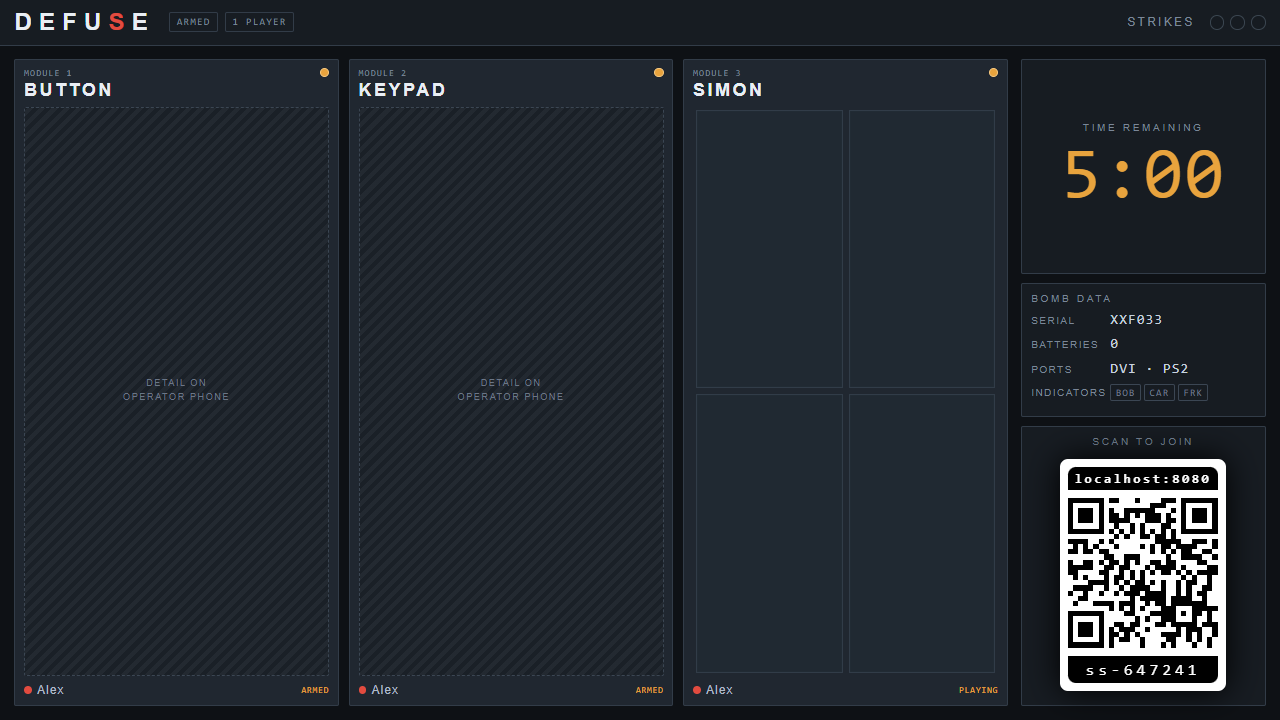
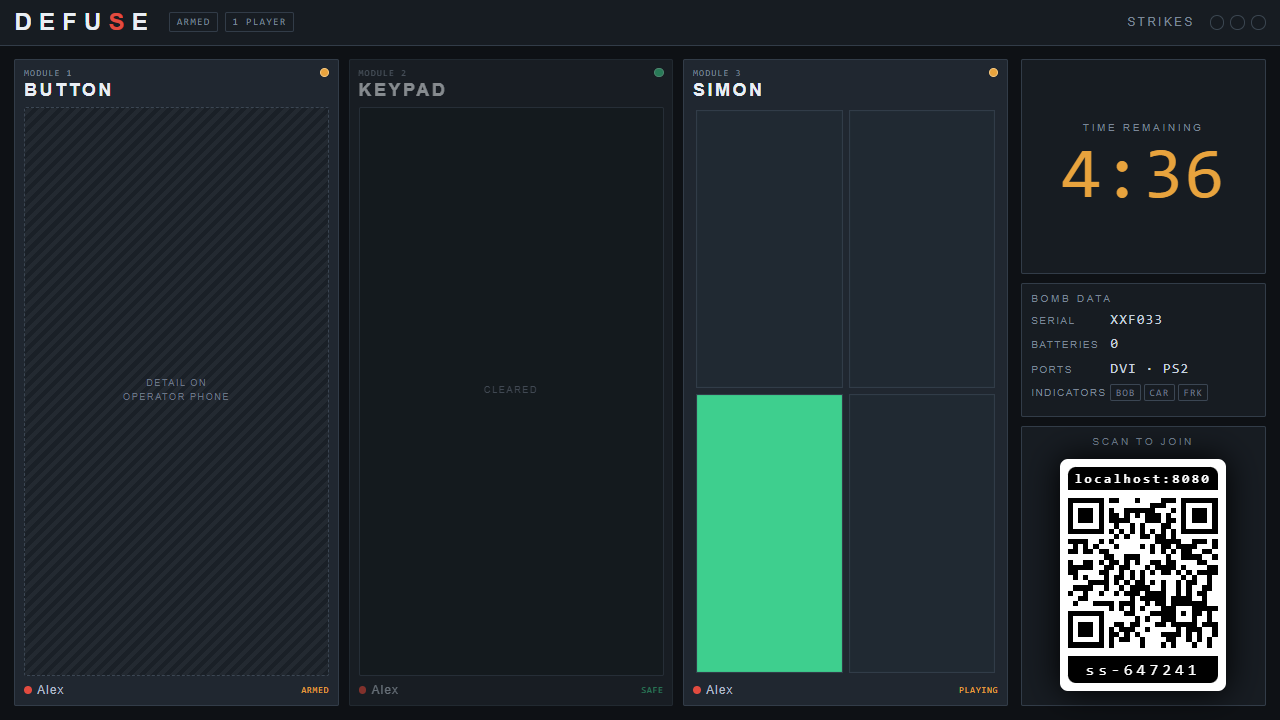
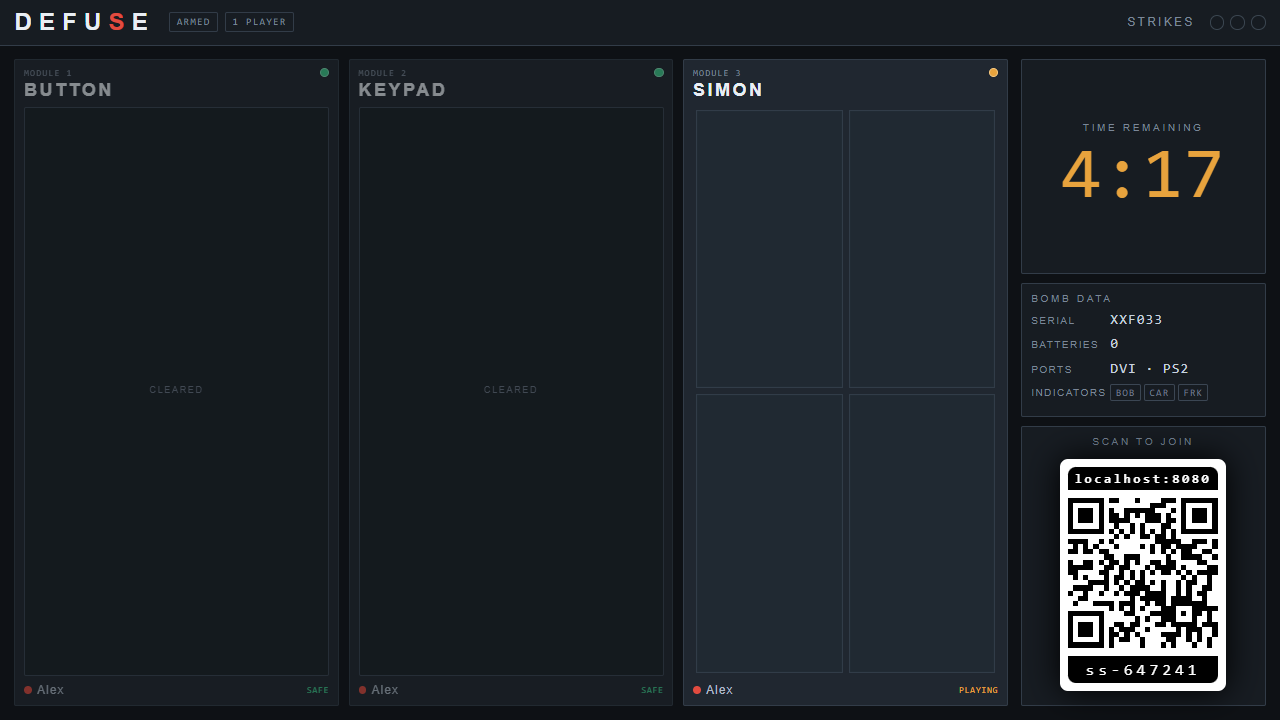
The viewer shows each module's number, type, operator and state, then hatching where the detail would be. Wire colours, keypad symbols and the button's wording live only on the operator's phone, so a manual holder cannot simply read the answer off the television.
Simon is the deliberate exception. Its sequence flashes on the big screen because the stimulus is public and only the colour mapping is secret, which gives the whole room one thing to watch together.
The serial number, battery count, ports and indicators stay permanently public beside the clock. They gate about half the rules and are the one panel everybody reads at once.
Modules
- Wires — three to six coloured wires. The rule depends on the wire count, the colours and whether the serial number ends odd.
- Keypad — four symbols that appear together in exactly one column of the manual. Press them in that column's order.
- The Button — a colour and a word decide whether it is tapped or held. A held button shows a coloured strip and must be released on a specific digit in the timer.
- Simon — a growing colour sequence flashed on the display, translated through a table keyed on the serial number and the current strike count.
The number of modules scales with the crew, up to six. Each strike speeds the clock up.
Screenshots